

Reliable Spare Parts and Components for Your Machines
Elevate your machinery performance with our premium spare parts and components. Trust in our quality and reliability for optimal operation and longevity.
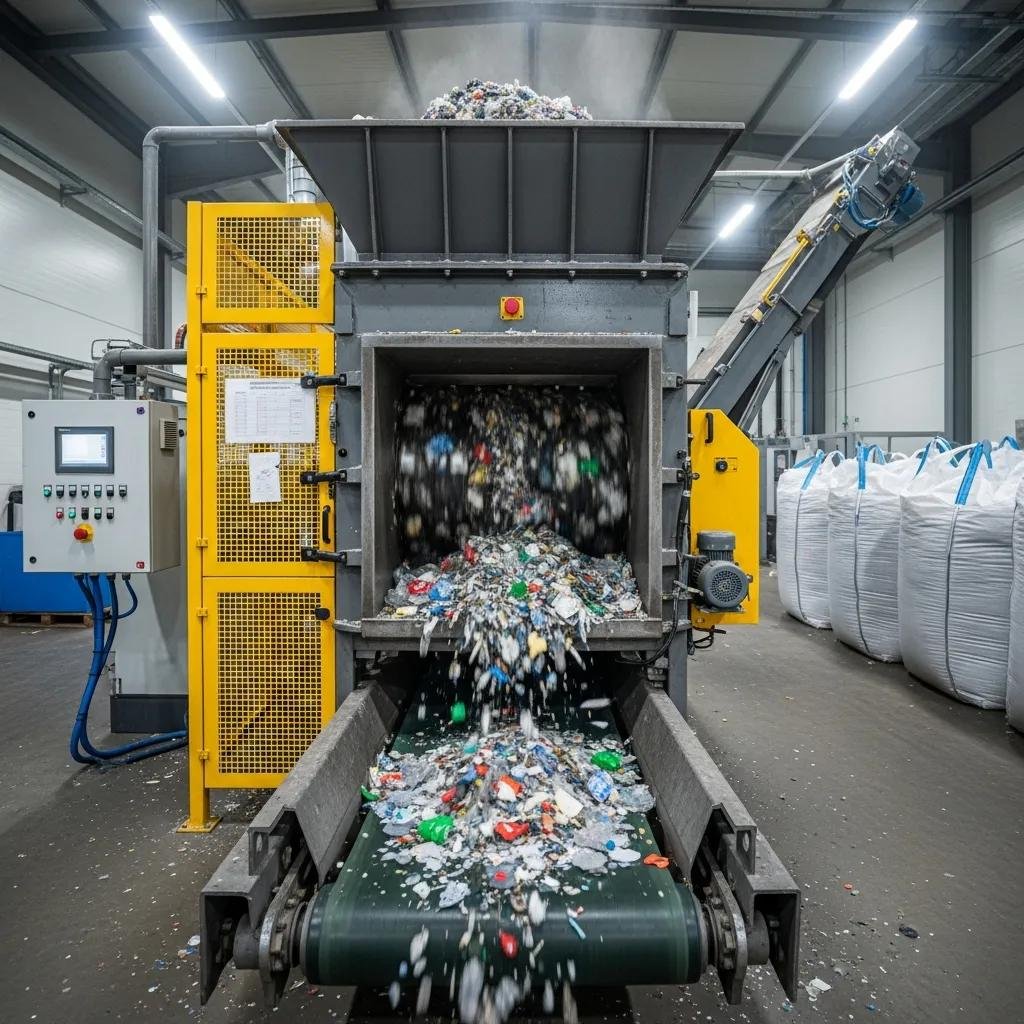
Heavy-duty plastic shredder machines are industrial-scale size-reduction systems that convert bulky plastic waste into smaller, transportable flakes or strips, enabling efficient downstream recycling and disposal. These machines apply mechanical shear and compression through rotors, blades, and screens to reduce material volume and prepare inputs for granulators, washing lines, and pelletizers, which lowers transport costs and improves recycling yield. This article explains how industrial plastic shredders operate, the plastic types and forms they handle, and how different shredder architectures match specific applications and throughput requirements. You will also find feature-to-benefit analysis of modern technologies—high-torque drives, blade design, PLC control—and quantifiable business and sustainability impacts of volume reduction. Finally, practical selection guidance and system-integration approaches will help you choose the right shredder or recycling line configuration for film, bags, PET bottles, HDPE containers, and mixed scrap. Read on for comparison tables, actionable checklists, and real-world integration guidance to streamline material size reduction and recycling workflows.
Heavy-duty plastic shredder machines are robust industrial shredding equipment designed to reduce the physical size and bulk of plastic waste, thereby lowering storage, transport, and disposal costs while enabling efficient recycling. These systems use rotors fitted with hardened blades, powered by high-torque motors and gearboxes, to cut, tear, and shear incoming materials into defined output sizes that downstream granulators and washers can process. By converting loose film, bale-packed film, bottles, and rigid scrap into flakes or strips, shredders achieve significant volume reduction—often compressing waste bulk and improving logistics efficiency. Understanding how shredders operate and what inputs they accept is the first step toward configuring a cost-effective recycling or waste-management workflow. The next paragraphs explain the mechanical sequence of feed, cutting, and output sizing and the common material forms handled by industrial shredders.
Kingdom Machine Co., Ltd. is a supplier with a product portfolio that includes plastic recycling machines and offers customization, energy-saving designs, and after-sales service tailored for film and bag recycling operations. Their market position emphasizes simple operation, easy maintenance, and integrated solutions for packaging film recycling, making them a practical contact for businesses seeking turnkey shredding and recycling equipment. For operational queries or to discuss how a shredding solution would integrate with an existing line, readers are encouraged to request a consultation with the supplier’s technical sales team. This supplier-focused note leads into the technical explanation of shredder mechanics and material compatibility that follows.
Industrial plastic shredders reduce waste volume by feeding material into a cutting chamber where rotating rotors and intermeshing blades apply shear forces that fragment the material into smaller pieces. Feed mechanisms—gravity chutes, conveyors, or hoppers—control input rate, while blade geometry and screen apertures determine final particle size; this combination turns large items into flakes that occupy less space and flow better to downstream equipment. Typical performance is described by throughput (kg/hr), motor power (kW), and reduction ratio (input volume to output volume), which together determine operational efficiency and economics. Examples: film and bags can be shredded at high throughput with anti-wrap features, while rigid containers require higher torque and sturdier blades for effective size reduction. The next subsection outlines material compatibility and handling notes that influence machine selection and blade configuration.
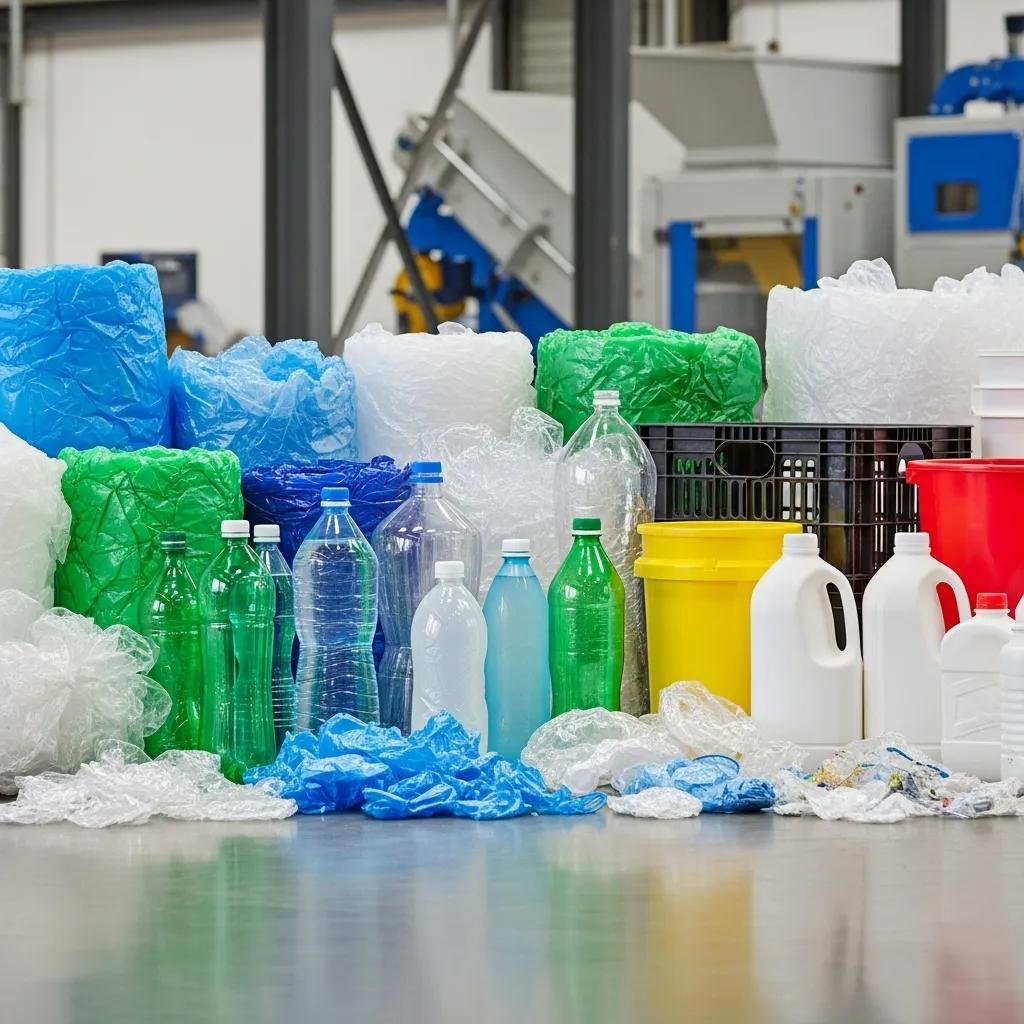
Industrial shredders can process a wide range of thermoplastics and common plastic waste forms including films, bags, bottles, containers, pipes, and purgings, provided the machine is configured appropriately for material toughness and contamination. Typical compatible polymers include PE (LDPE, LLDPE, HDPE), PP, PET, PVC (with caution for chlorine handling), PS, and mixed polymer scrap; wet or contaminated streams may require pre-sorting or washing to prevent performance loss. Operators must consider contamination levels, moisture, and film wrap potential—films often need anti-wrap rotor designs or film-openers to avoid clogging, while rigid materials need high-torque drives and thicker blades. The next section compares shredder architectures so you can match machine type to feedstock form and throughput needs.
Different shredder architectures suit distinct applications and feedstocks; selecting the right type depends on material form, throughput, and downstream sizing needs. Single-shaft shredders typically offer controlled output with screens and are space-efficient for rigid parts, while dual- and four-shaft shredders excel at handling bulky, mixed, or high-wrap materials due to anti-wrap designs and higher torque handling. Granulators complement shredders when final particle size control is critical and when a two-stage approach (shredder → granulator) improves overall throughput and product quality. Operational considerations include maintenance access, footprint, noise, and how the shredder integrates with conveyors, hoppers, and downstream washing systems. The following comparison table maps shredder types to typical applications and outputs to help narrow choices quickly.
Single-shaft plastic shredders feature a single rotating shaft with mounted blades that shear material against stationary knives and a discharge screen, producing consistent flake sizes suitable for granulation. They are best for rigid, uniform feedstocks where screen control can deliver predictable output, and they often require less complex maintenance than multi-shaft units due to simpler rotor geometry. Typical industries include injection molding regrind processing and rigid container recycling where controlled output and pairing with granulators ensure efficient downstream pelletizing. Regular blade inspection and screen management maintain cut quality and throughput. Understanding single-shaft operation helps determine when to choose a simpler, lower-footprint shredder versus a more robust multi-shaft solution.
Dual-shaft and four-shaft shredders use intermeshing rotors to produce high-torque, anti-wrap cutting action that feeds and tears bulky or film-heavy loads without clogging, making them suited for mixed or contaminated streams. The self-feeding action and dual-rotor torque handling allow these machines to process film bales, tangled bags, and large purgings more reliably than single-shaft units, though they may require higher maintenance for bearing and drive components. Throughput depends on rotor diameter, shaft speed, and motor torque; operators balance these factors to avoid jams while maximizing capacity. Selecting a multi-shaft design is often the correct choice when feed variability and material entanglement are primary operational concerns.
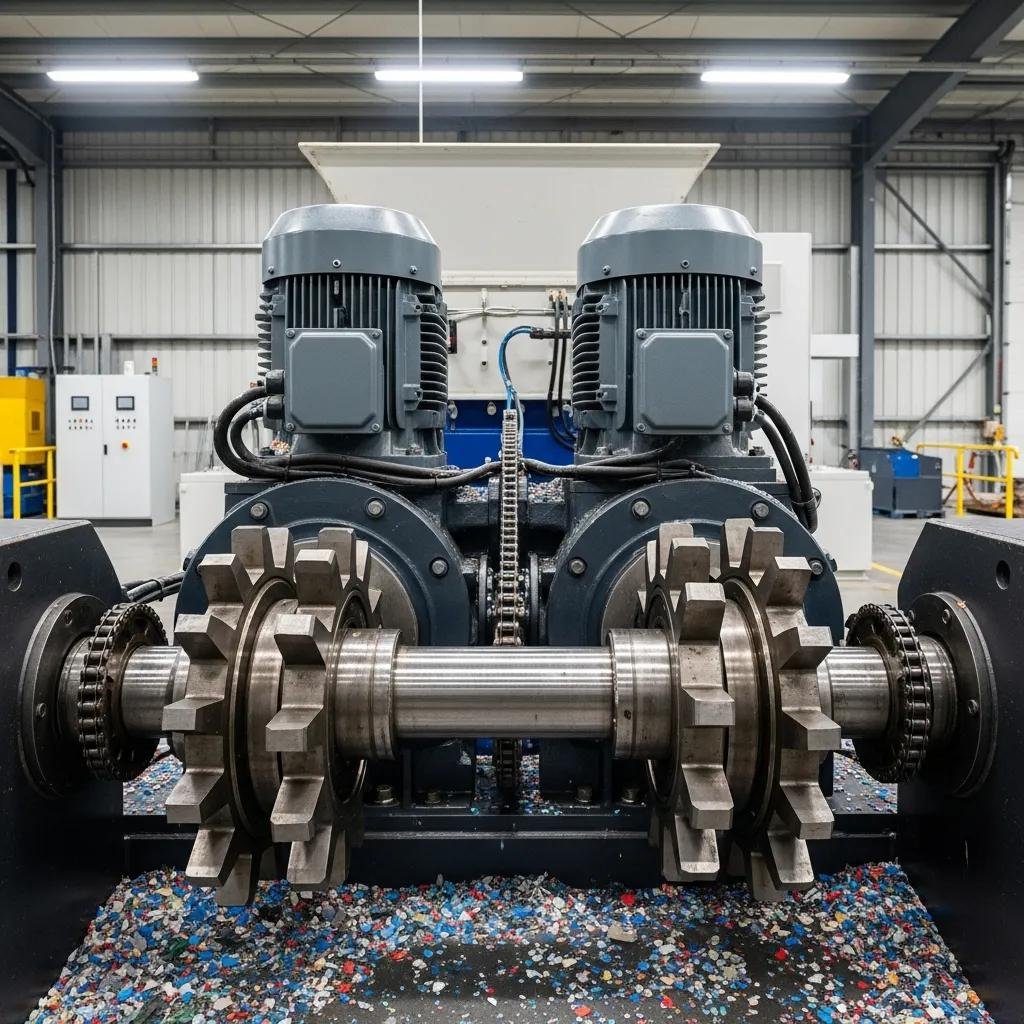
Performance of heavy-duty plastic shredders depends on a combination of mechanical components and control technologies that together determine throughput, uptime, and output quality. Key elements include high-torque motors and robust gearboxes for processing bulky or rigid materials, customizable blade sets and screen options for precise sizing, and PLC-based control systems with safety interlocks and diagnostics that protect equipment and optimize operation. Energy-efficient drives and modular designs reduce lifecycle costs and simplify maintenance, while condition monitoring enables predictive service and minimized downtime. The following table maps core components to their operational benefits and example impacts so you can prioritize features when specifying equipment.
High-torque motors provide the force needed to shear heavy, rigid, or tangled materials without frequent stalls, enabling steady throughput even with variable feedstocks. Blade material selection (hardened tool steels, wear-resistant coatings) and geometry (shear cut, guillotine) determine cut quality, wear life, and maintenance intervals; replacing blades on schedule preserves output size and reduces energy use. Customizable blade sets and screen options allow operators to tune particle size for downstream washing and granulation requirements, improving recycling yields and process efficiency. Proper matching of torque, blade configuration, and screen aperture materially increases productive uptime and lowers cost per ton processed.
PLCs centralize control, enable automated sequencing (feed rate, auto-reverse, timed cycles), and collect fault diagnostics that speed troubleshooting and reduce unplanned downtime in shredding operations. Safety interlocks, emergency stops, and guarded access points protect operators and ensure compliance with workplace safety norms, while condition monitoring features can flag bearing wear or motor overload before failures occur. Remote diagnostics and Industry 4.0 connectivity options support predictive maintenance strategies and allow technicians to tune parameters for different materials, improving both safety and throughput. These controls make modern shredders more reliable and easier to operate in high-volume industrial environments.
Heavy-duty shredders produce direct financial savings and environmental benefits by reducing transport volumes, lowering disposal fees, and creating saleable regrind that offsets virgin resin purchases. Volume reduction reduces logistics frequency and cost, and consistent output sizes improve washing and pelletizing efficiency, increasing recycling yield and product quality. Environmentally, shredding is the critical first step that enables closed-loop recycling, diverts plastic from landfill or incineration, and helps organizations meet regulatory recycling targets and circular-economy objectives.
The next table quantifies common business benefits and provides example metrics to help estimate potential ROI for implementing industrial shredding.
Volume reduction directly reduces the number of transport cycles and the space required for storage and handling, thereby lowering fuel, labor, and rental costs associated with waste logistics. By producing a consistent flake size, shredders improve downstream washing and granulation efficiencies, which in turn reduces energy per ton processed and increases yield of clean regrind suitable for resale or internal reuse. Measuring ROI typically involves calculating payback period from savings in transport and disposal plus reclaimed material value; many operations find payback within a few years depending on throughput and local waste costs. Considering both capital cost and lifecycle operating expenses yields the most accurate financial picture when justifying equipment investment.
Shredders make circular-economy practices possible by turning heterogeneous plastic waste into standardized feedstock that can be washed, pelletized, and reintroduced into production or sold as recyclate. Shredding improves material homogeneity, enabling higher-quality separation and washing, which increases the proportion of reclaimed material suitable for higher-value applications. By supporting closed-loop processing—especially for film and packaging streams—shredders help manufacturers and waste handlers meet recycling mandates and corporate sustainability goals. The operational improvements discussed above naturally lead to selection questions: how to choose the right machine to match material type, throughput, and budget constraints.
Choosing the right shredder requires a structured decision framework that considers material type and form, required throughput, desired output size, available footprint, maintenance capacity, and budgeted capital versus lifecycle operating costs. Begin by quantifying incoming stream characteristics (polymer types, contamination, moisture, bale vs loose), then map those to machine classes (single-shaft for rigid, multi-shaft for mixed/bales). Evaluate motor torque, blade options, screen sizing, PLC capabilities, and downstream compatibility with granulators and washing lines to ensure balanced throughput across the entire recycling line. Use the checklist below to guide procurement conversations and to create clear specifications that vendors can quote against.
This checklist helps translate operational needs into technical specifications; the following paragraph explains how Kingdom Machine Co., Ltd. supports customization and consultation for specific industrial applications.
Material type drives decisions on torque, blade hardness, and rotor design because films require anti-wrap features while rigid HDPE or PET demands higher cutting force and wear-resistant blades. Throughput determines motor sizing and gearbox ratios; a conservative design includes a capacity buffer for variations in feed consistency and contamination. Budget decisions should weigh capital expense against operating costs—investing in energy-efficient drives, modular maintenance access, and robust blade materials often reduces total cost per ton over the machine lifetime. Balancing these factors ensures the selected shredder meets both performance and financial objectives while minimizing unexpected downtime and maintenance expenses.
Kingdom Machine Co., Ltd. (also listed under the name China Evergreen Machinery Co., Ltd. in some industry listings) offers flexible customization and integration services for plastic recycling equipment, emphasizing simple operation, easy maintenance, and energy-saving designs. Their capabilities include configurable blade sets, tailored feed hoppers, and systems integration with granulators, washing lines, and pelletizers, supported by timely after-sales service and R&D-driven adaptations for packaging film recycling. For operations that require a tailored solution, a consultation can identify the optimal configuration, balancing throughput, size reduction targets, and budget constraints. Prospective buyers are encouraged to request a customized quote and system design consultation to align equipment selection with operational goals.
Complete plastic recycling lines typically sequence heavy-duty shredders, granulators, washing systems, drying, and pelletizing to convert waste into saleable recyclate or internal feedstock, with conveyors, separators, and storage buffers ensuring throughput balance. Effective system design matches shredder output size and capacity to granulator intake and wash-line handling, while water, energy, and contamination control strategies determine overall process yields. Line-level considerations include buffer storage to decouple upstream and downstream variations, screening and density separation for mixed streams, and wastewater management for wet processing. The next subsections outline technical matching of components and provide illustrative case-style examples of system outcomes and best practices.
Kingdom Machine Co., Ltd. can supply or help integrate these components as part of a recycling line offering, providing design support that considers throughput balancing, energy efficiency, and after-sales maintenance. Businesses interested in a turn-key or modular integration are advised to request a system-level consultation to evaluate process flows, equipment compatibility, and expected recovery metrics. This supplier integration note follows naturally from the system design guidance and assists readers in taking the next step toward implementation.
Shredder output size and moisture content are critical inputs for effective granulation and washing: granulators perform best with pre-shredded material sized to the granulator’s intake specs, while washing systems require flakes within a target size range to achieve optimal contamination removal. Throughput matching is essential—buffer hoppers and conveyors ensure continuous feed to granulators and washing lines, preventing bottlenecks and maximizing equipment utilization. Key engineering considerations include selecting screen apertures for desired particle size, providing dewatering and drying stages post-wash, and ensuring conveyors and feeders handle the material’s bulk density and flow characteristics. Anticipating these integration issues avoids performance mismatches and improves recycling yields.
Illustrative industry examples show that integrating heavy-duty shredders with washing and granulation can reduce transport volumes by 30–60% and increase recycled-product value by producing uniform flakes and pellets suitable for reprocessing. One anonymized case involved converting film-bale inputs through a dual-shaft shredder and washing line to produce clean flakes that fed a pelletizer, resulting in a measurable drop in logistic costs and a higher proportion of material acceptable for industrial resale. Another example used a single-shaft shredder paired with a granulator to reclaim rigid HDPE scrap, reducing on-site storage needs and enabling internal reuse, which lowered virgin resin purchases. These cases highlight system-level planning, correct machine selection, and ongoing maintenance as keys to achieving the reported benefits.
Each example shows that careful sizing, blade selection, and throughput balancing yield measurable operational and sustainability improvements, underscoring the importance of detailed process design when implementing recycling lines.
Elevate your machinery performance with our premium spare parts and components. Trust in our quality and reliability for optimal operation and longevity.
Maximize efficiency with expert installation for your plastic production machines. Our professional team ensures optimal performance tailored to your needs.

Transform your concepts into reality with our tailored installation solutions. Experience professional guidance and exceptional results designed just for you.

Elevate your production with essential tips for selecting the right plastic bag making equipment. Make informed choices for efficiency and quality today.
